Conscience, Lion

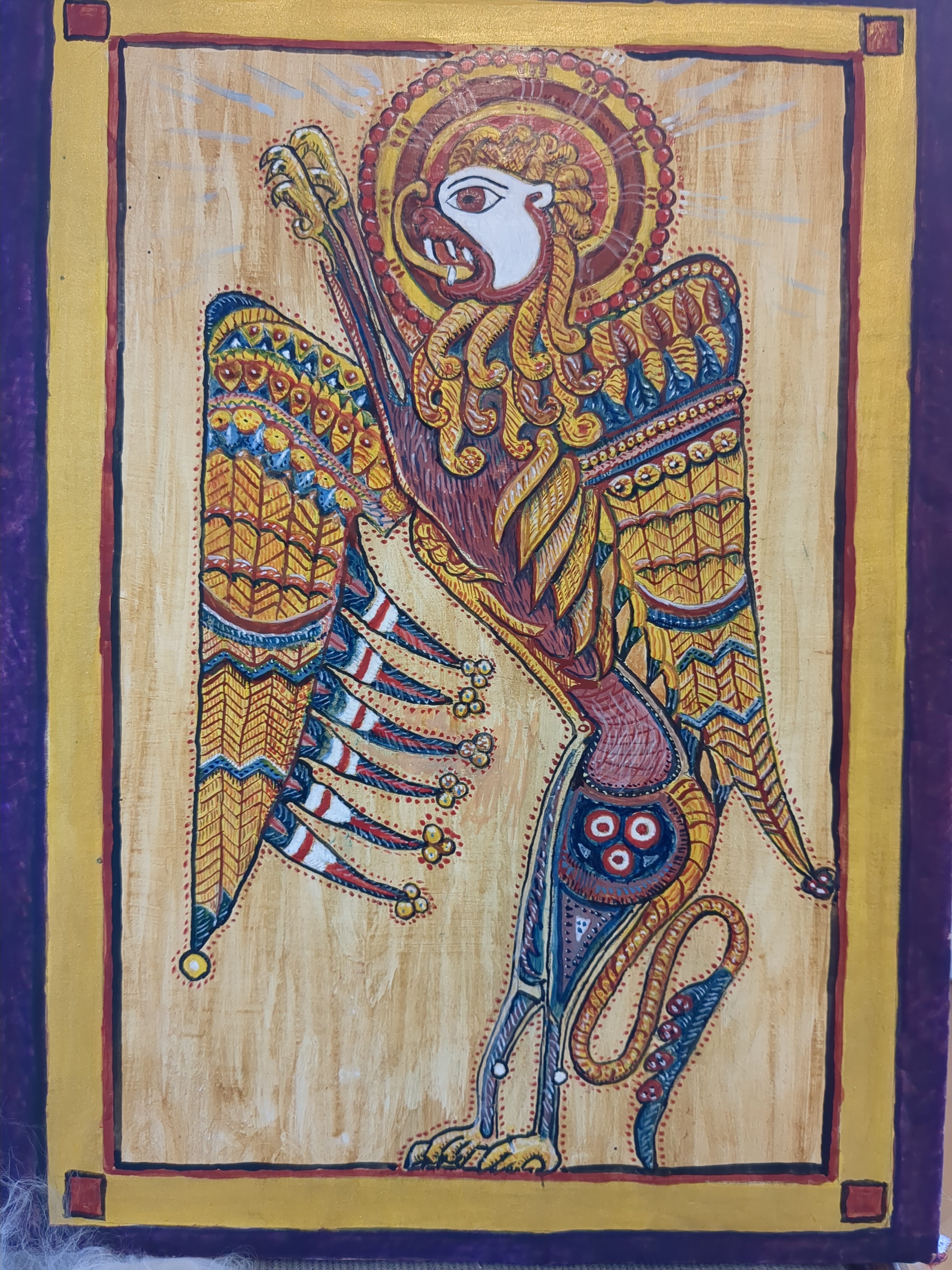
I just finished this. Egg Tempera on Wood Panel 12x16in. Natural pigments. Gesso is 7-layer rabbit skin glue and powdered marble. Based upon one of the version in the Book of Kells,
Hilary White just published an excellent article on the 4 “beasts” of Christian iconography. I highly recommend Hilary’s substack site.
My interest in the Lion, the Bull, the Eagle, the Man has recently been revived as I learned that those four image metaphors are aspects of Conscience, or what it takes to contact Conscience, in the early Christian corpus. This is a new study for me, so I will not say much more about it. I was just tickled that Hilary is also having an interest in this rather profound topic.
Congrats on the artwork.
The four that usually go together are the Angel, the Lion, the Bull and the Eagle. These represent the four evangelists. Angel: Matthew; Lion: Marco; Bull: Luke, and Eagle: John.
The Lion is well known from Piazza San Marco in Venice.
The cathedral in the town of Alba, northern Italy, has the statues of the four on its front elevation. In fact, I think that the the town was named Alba because of Angelo, Leone, Bue, Aquila.
Michael,
Human = Aquarius, Lion = Leo, Bull = Taurus, Eagle = Scorpio; the four living creatures of the prophet Ezekiel. All of these can be found as one representation in Babylonian/ Assyrian art/ sculptures. https://www.britishmuseum.org/collection/object/W_1851-0902-509
They represent the so-called Great Year. Assuming one will accept that humanity is older and was far more advanced earlier than what we are presently told.
Jesus Christ is "the lamb of God." Lamb and variants = Aries, in early Christianity Christ was represented as a lamb. "By the Sixth Synod of Constantinople (Canon 82), it was ordained that instead of the ancient symbol which had been the lamb, the figure of a man nailed to a cross should be represented. All this was confirmed by Pope Adrian I (772 - 795AD).
The Pope’s mitre symbolically represents a fish-head = Pisces.
I can recommend 'Species with Amnesia' by Robert Sepehr.